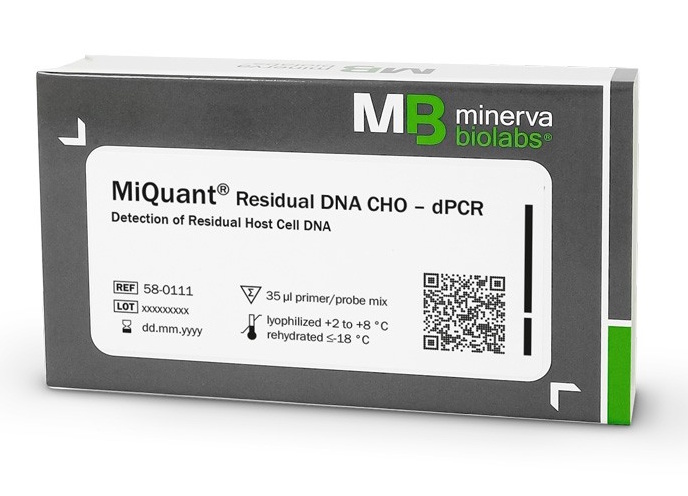
MiQuant® Residual DNA CHO – dPCR
Digital PCR assay for the quantitative determination of residual host cell DNA from CHO cells.
- Direct testing without DNA extraction
- Meets EP, WHO, and FDA criteria
- Universally compatible with dPCR and ddPCR™ platforms
Product Description
CHO cells are established production cell
lines for recombinant biopharmaceuticals, such as monoclonal antibodies
and therapeutic proteins. Residual CHO DNA is considered a
process-related impurity and must be reliably quantified and controlled
throughout the manufacturing process.
WHO and FDA guidelines define risk-based limits that depend, among
other factors, on the cell substrate, route of administration, and the
tumorigenic and oncogenic potential of the residual DNA. For certain
parenterally administered products derived from non-tumorigenic cell
lines, less than 10 ng of residual DNA per dose and DNA fragments of
approximately 200 bp or smaller are used as reference values.
MiQuant® Residual DNA CHO - dPCR is a digital PCR assay for the
quantitative determination of residual CHO DNA in chemical and
biological matrices. The assay was developed for research and quality
control in biopharmaceutical manufacturing processes.
Samples can be analyzed directly without prior DNA extraction. This
reduces the total workflow to less than three hours and prevents
potential DNA loss during purification.
By amplifying a short multicopy target sequence within the CHO
genome, the assay enables the sensitive detection of highly fragmented
or degraded CHO DNA. The assay achieves the quantification limit of 10
fg/µl described in Ph. Eur. 2.6.35.
Digital PCR enables direct sample analysis without prior DNA
extraction. It also allows absolute quantification without the need for a
standard curve. Using the dPCR Validation Standard CHO,
a matrix-specific conversion factor can be determined to convert
[copies/µl] into [fg/µl], enabling the quantification of residual DNA in
accordance with applicable regulatory guidelines.
Specifications
| Application |
Quantification of residual DNA from CHO host cells |
| Application areas |
- QC release of biopharmaceuticals and ATMPs
- QC testing after purification steps
- research applications
|
| Contents |
- MiQuant® CHO Mix (lyophilized)
- Positive Control DNA (lyophilized)
- Internal Control DNA (lyophilized)
- dPCR grade Water
|
| Compliance |
EP 2.6.35, WHO, FDA |
| Validation report |
available |
| Time-to-result |
< 3 h |
| PCR type |
- digital PCR
- digital droplet™ PCR
|
| Compatible devices |
QIAcuity®, Quantstudio™ Absolute Q™, QX200™/QX600™ ddPCR™ |
| Detection limit (LOD) |
≤ 0.04 fg/μl |
| Target |
Chinese Hamster Ovary |
| Control system |
- Positive control
- Internal control
|
| Number of reactions |
- 58-0111:
- QIAcuity® 26k plate: 8 reactions
- QIAcuity® 8.5k plate: 26 reactions
- QX200™/QX600™ ddPCR™: 16 reactions
- Quantstudio™ Absolute Q™: 32 reactions
- 58-0112:
- QIAcuity® 26k plate: 32 reactions
- QIAcuity® 8.5k plate: 106 reactions
- QX200™/QX600™ ddPCR™: 64 reactions
- Quantstudio™ Absolute Q™: 128 reactions
|
| Price per reaction |
- 58-0111:
- QIAcuity® 26k plate: €23,75
- QIAcuity® 8.5k plate: €7,31
- QX200™/QX600™ ddPCR™: €11,88
- Quantstudio™ Absolute Q™: €5,94
- 58-0112:
- QIAcuity® 26k plate: €21,72
- QIAcuity® 8.5k plate: €6,56
- QX200™/QX600™ ddPCR™: €10,86
- Quantstudio™ Absolute Q™: €5,43
|
Required equipment
and consumables |
- dPCR and ddPCR™ cycler with FAM™ and HEX™ detection channels, including the corresponding master mix and consumables
- PCR reaction tubes
- Centrifuge for 1.5 ml PCR reaction tubes
- Vortex mixer
- Pipettes with corresponding filter tips
Optional: dPCR Validation Standard CHO (Cat. No. 58-0211) |
| Storage |
2-8 °C; ≤ –18 °C after rehydration |
| Shipping |
Ambient temperature |
| Shelf life (max.) |
18 months |
Regulatory Disclaimer
For research and industrial use only. Not for diagnostic or therapeutic use.
Minerva Biolabs offers a free sample of this product for testing:
Resources
If you cannot find the answer to your problem then please contact us or telephone +44 (0)1954 210 200