- All-in-one kit to produce N1-methyl-pseudouridine-containing, fully 5’ capped and 3’ poly(A) tailed mRNA (N1meΨ-mRNA).
- Combine the benefits of high-yield transcription with post-transcriptional capping and tailing.
- Produce large amounts of N1meΨ-mRNA with virtually 100% transcript capping.
- Create variable 3’ poly(A) tail lengths, from 50 to >300 A’s.
- Lower immunogenicity in mammalian cells through incorporation of N1meΨ in synthesized mRNA.
Product is for research use only (RUO)
Product Description: 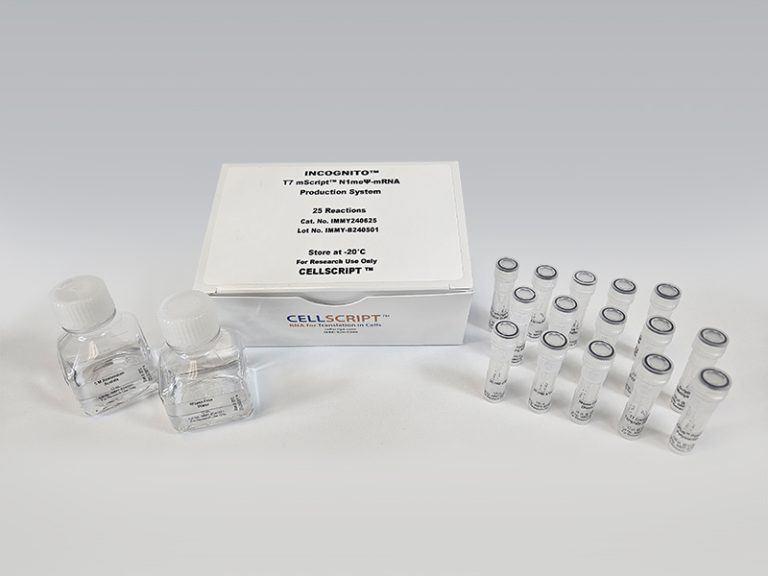
The INCOGNITO™ T7 mScript™ N1meΨ-mRNA Production System provides all
enzymes and reagents for making low immunogenicity
N1-methyl-pseudouridine (N1meΨ)-containing, 5'-capped and
3'-polyadenylated mRNA. The kit includes reagents for four workflow
modules, (1) high-yield in vitro transcription of linear
double-stranded DNA templates using the T7 mScript™ Enzyme Solution, the
canonical nucleotides ATP, CTP, GTP and the modified nucleotide
N1-methyl-pseudouridine-5'-triphosphate (N1meΨTP), (2) enzymatic capping
of the RNA using the ScriptCap™ Cap 1 Capping System (contains both ScriptCap™ Capping Enzyme and 2'-O-Methyltransferase) for making mRNA with a Cap 1 cap structure, (3) A-Plus™ Poly(A) Polymerase for adding a 3'-poly(A) tail and (4) 5 M NH4OAc as a convenient RNA/mRNA purification method.
Post-transfection, capped and tailed mRNA has increased stability and
translation efficiency in most eukaryotic cell lines. Additionally, it
has been shown that N1meΨ-mRNAs are translated into protein at higher
levels and induce lower innate immune responses in humans and other
mammalian cells that express various RNA sensors compared to
corresponding unmodified mRNAs. The INCOGNITO™ mScript™ System generates
modified mRNA with virtually 100% transcript capping and user-defined
poly(A) tail length. Poly(A) tail lengths can be generated much longer
than is possible using a template-encoded tail, even greater than 300
A’s. This mRNA is suitable for use in transfection and microinjection
experiments as well as in vitro translation systems.
For maximum reduction of immunogenicity, combine INCOGNITO™ N1meΨ-mRNA with the Min-Immune™ Gold dsRNA Removal Kit
to produce virtually dsRNA-free, ultra-low immunogenicity mRNA that is
suitable for downstream applications, such as cell and gene therapy
research and mRNA vaccine development.
Uses and Label Licenses for Specific Products:
Purchaser
receives a limited non-exclusive, non-transferable right to use the
Products purchased from CELLSCRIPT™ solely for its own internal
laboratory research use. See the Licensing tab for more information.
Materials Supplied
Important Store at -20°C in a freezer without a defrost cycle. Do not store at -70°C.
|
INCOGNITO™ T7 mScript™ N1meΨ-mRNA Production System Kit Contents 25 Reactions. (Module 1 of 4) |
|
Kit Module |
Kit Component |
Reagent Volume |
|
In Vitro Transcription |
T7 mScript™ Enzyme Solution |
50 µl |
|
10X T7 mScript™ Transcription Buffer II |
50 µl |
|
100 mM Dithiothreitol (DTT) |
50 µl |
N1meΨTP PreMix
25 mM each GTP, ATP, N1meΨTP, CTP |
180 µl |
|
RNase-Free DNase I, 1 U/μl |
25 µl |
|
|
INCOGNITO™ T7 mScript™ N1meΨ-mRNA Production System Kit Contents 25 Reactions. (Module 2 of 4) |
|
Kit Module |
Kit Component |
Reagent Volume |
|
Post-Transcriptional Capping |
ScriptCap™ Capping Enzyme, 10 U/μl |
100 µl |
|
ScriptCap™ 2'-O-Methyltransferase, 100 U/μl |
100 µl |
10X ScriptCap™ Capping Buffer
0.5 M Tris-HCl (pH 8.0), 60 mM KCl and 12.5 mM MgCl2 |
250 µl |
|
20 mM S-adenosyl-methionine (SAM) |
125 µl |
|
20 mM GTP |
125 µl |
|
|
INCOGNITO™ T7 mScript™ N1meΨ-mRNA Production System Kit Contents 25 Reactions. (Module 3 of 4) |
|
Kit Module |
Kit Component |
Reagent Volume |
|
Poly(A) - Tailing |
A-Plus™ Poly(A) Polymerase, 4 U/µl |
130 µl |
10X A-Plus™ Poly(A) Tailing Buffer
0.5 M Tris-HCl (pH 8.0), 2.5 M NaCl and 100 mM MgCl2. |
300 µl |
|
20 mM ATP |
150 µl |
|
|
INCOGNITO™ T7 mScript™ N1meΨ-mRNA Production System Kit Contents 25 Reactions. (Module 4 of 4) |
|
Kit Module |
Kit Component |
Reagent Volume |
|
Common Usage |
ScriptGuard™ RNase Inhibitor, 40 U/µl |
90 µl |
|
RNase-Free Water |
12 ml |
|
5 M Ammonium Acetate |
12 ml |
T7 Control Template DNA: Is a linearized 4.1 kb
plasmid that contains a T7 promoter followed by a phage lambda dsDNA
insert that encodes a 1,375 base runoff transcript. The Control Template
DNA is provided at a concentration of 0.5 µg/µl in T10E1 Buffer (10 mM Tris-HCl, pH 7.5, 1 mM EDTA).
Materials Required, but not Supplied
- A DNA template for transcription of your RNA of interest
- Materials or kits for purification of the RNA product
- RNase-free TE Buffer (10 mM Tris-HCl, pH 7.5, 1 mM EDTA)
- Optional: TE saturated phenol/chloroform, 0.5-1 M EDTA
Terms and Conditions: The Product listed is currently offered by CELLSCRIPT™ for research use only under the defined Terms and Conditions.
Troubleshooting guide:
|
Synthesis of IVT RNA |
|
Symptom |
Solution |
Low yields or less than full-length
transcripts |
Cleanup the templates to remove any RNase or other contaminants. |
|
Verify that ScriptGuard™ RNase Inhibitor was added to the reaction. |
Extend the incubation time.
Do not extend the reaction time beyond 3 hours. |
|
Increase the template concentration. |
|
Increase the reaction temperature to 42oC. |
|
Assembled reaction formed an insoluble precipitate |
Repeat assembly of the reaction at >22oC.
|
|
White precipitate in reaction buffer |
Incubate the reaction buffer at 37oC for 5 minutes then mix thoroughly to dissolve the precipitate. |
|
Do not store the kit at –70oC. |
|
|
Synthesis of Capped RNA |
|
Symptom |
Solution |
|
Low capping efficiency |
Cleanup the templates to remove any RNase or other contaminants. |
|
Verify that ScriptGuard™ RNase Inhibitor was added to the reaction. |
|
SAM slowly degrades at room
temperature and above. Keep SAM solutions on ice at all times.
|
|
Increase the capping reaction incubation time. For example, up to 3 hours at 37oC. |
|
Some RNAs form stable structures
(e.g., homodimers, hairpins) at the 5' end, limiting access by Capping
Enzyme or 2'-O-Methyltransferase. Analyze the sequence and increase the
RNA denaturation temperature to above the Tm (e.g., to 65oC for 20 min, 75oC for 10 min, 85oC
for 5 min). If the 5' end is highly structured, it might be necessary
to modify the 5' end sequence using molecular biology techniques. Often
this can be accomplished by making a single point mutation within the
first 5 bases of the DNA template for the RNA transcript (non-coding
region).
Contact CELLSCRIPT™ Technical Services for suggestions and recommendations. |
|
White precipitate in reaction buffer |
Incubate the reaction buffer at 37oC for 5 minutes then mix thoroughly to dissolve the precipitate. |
|
Do not store the kit at –70oC. |
|
|
Synthesis of Poly(A)-Tailed RNA |
|
Symptom |
Solution |
|
Poly(A) tails are longer than expected |
Decrease the time of incubation of the reaction. |
|
Decrease the amount of A-Plus™
Poly(A) Polymerase used in the reaction. |
|
Poly(A) tails are shorter than expected |
Increase the time of incubation of the reaction. |
|
Increase the amount of A-Plus™
Poly(A) Polymerase used in the reaction. |
|
No poly(A) tails are observed |
Enzyme is inactive. Store only at –20oC.
Keep on ice when not in the freezer. |
ATP is hydrolyzed.
Do not expose to elevated temperatures. |
FAQs: For answers to Frequently Asked Questions about our products, visit the FAQ library.
If you cannot find the answer to your problem then please contact us or telephone +44 (0)1954 210 200