This protocol describes how to determine genome targeting efficiency by digesting annealed mismatched PCR products with T7 Endonuclease I. In the first step, PCR products are produced from the genomic DNA of cells whose genomes were targeted using Cas9, TALEN, ZFN etc. In the second step, the PCR products are annealed and digested with T7 Endonuclease I. If two shorter fragments of the expected size are generated, which means that it has successfully introduced mutations small insertions and deletions (indels typically 2~20bp) are present at the targeted chromosomal site. Fragments are analyzed to determine the efficiency of genome targeting.
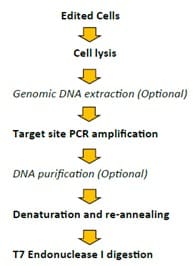
Procedures
I. Sample Preparation
Option 1: Genomic DNA extraction
Harvest cells and extract genomic DNA according to the manufacturer extraction protocol.
Option 2: Cell lysate preparation
Collect cells and add 50-100 μL Lysis buffer and lyse cells at 95º C for 5-10 min.
II. PCR Amplification
1. Thaw the kit components, mix and pulse-spin in microfuge each component prior to use.
2. Set up a 50 µl PCR reaction using up to 100-200 ng of genomic DNA as a template. Assemble the following reaction:
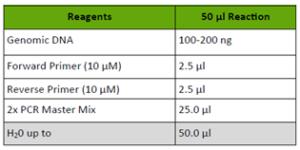
3. Mix the reaction and transfer the tubes to a PCR machine with the following thermocycling conditions:
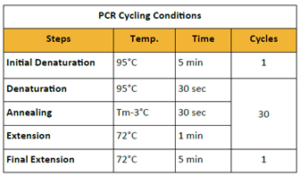
4. Run 3-5 μL of the PCR product on a 1-2 % agarose gel. The final PCR product should be within the range of 600 – 1000bp.
5. (Optional) If necessary, purify the DNA by using either gel extraction kit or ampure XP beads according to the manufacturer protocol
III. Hybridization (Denaturation and re-annealing)
1. Assemble reactions as follows:
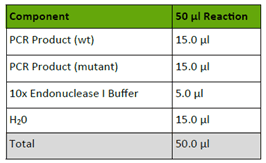
2. Mix the reaction gently.
3. Heat at 95º C for 5 min by using a heat block. Thermocyler can also be used for hybridization.
4. Turn off the heat block and cool down gradually to room temperature.
T7 Endonuclease I digestion
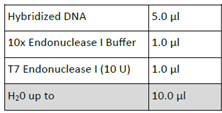
1. Assemble reactions as follows:
2. Incubate at 37º C for 15-30 min.
3. Stop the reaction by adding 1.0 µl of 0.5 M EDTA.
4. Run 1-2 % agarose gel to see the cleavage efficiency. A typical gel for Endonuclease I (Endo I) cleavage is shown below:
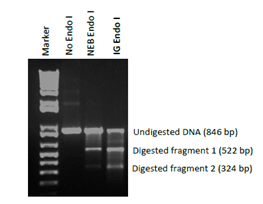
Figure 1: T7 endonuclease I activity testing: Double-stranded (ds) DNA fragments containing two types of sequences are PCR amplified, denatured and annealed to produce mismatched (heterologous) dsDNA. Purified mismatched dsDNA digested with Endonuclease I from NEB and Intact Genomics (ig) to compare the enzyme efficiency.
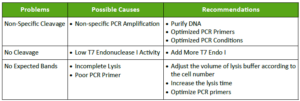
Tips: Design primers flanking the modification with predicted asymmetric bands after cleavage by T7 Endonuclease I. Otherwise if equal sized fragments result from cleavage they will co-migrate on the gel and cannot be differentiated.
If you cannot find the answer to your problem then please contact us or telephone +44 (0)1954 210 200