HB101 Chemically Competent Cells
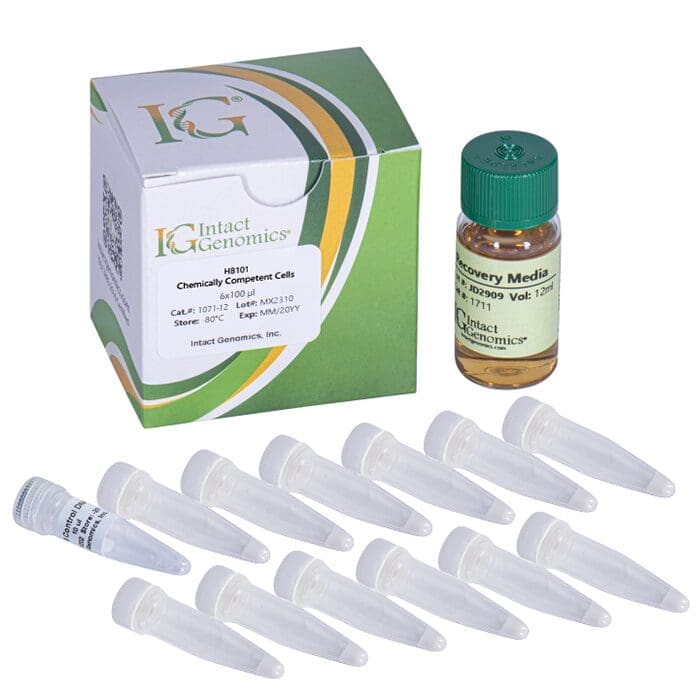
Intact Genomics (ig®) HB101 chemically competent E. coli cells are suitable for high-efficiency transformation in a wide variety of applications such as cloning and sub-cloning. E. coli HB101 is a K12 x B hybrid strain, containing the recA13 mutation that minimizes recombination and helps insert stability. In addition, it carries the hsdS20(rB-mB-) restriction minus genotype which prevents cleavage of cloned DNA by endogenous restriction enzymes. HB101 strain does not support Alpha-complementation for blue/white screening.
Product Description
Specifications
Competent cell type: Chemically competent
Derivative of: HB101
Species: E. coli
Format: Tubes
Transformation efficiency: ≥1 x 10⁸ cfu/µg pUC19 DNA
Blue/white screening: No
Shipping condition:Dry ice
Reagents Needed for One Reaction
ig® HB101 chemically competent cells: 50 µl
DNA (or pUC19 Control, 10 pg/µl): 1 µl
Recovery medium: 1 ml
Storage
ig® HB101 competent cells: -80 ºC
pUC19 control DNA: -20 ºC
Recovery medium: 4 ºC
Genotype
F- Lambda- araC14 leuB6(Am) DE(gpt-proA)62 lacY1 glnX44(AS) galK2(Oc) recA13 rpsL20(strR) xylA5 mtl-1 thiE1 hsdS20(rB-, mB-)
Quality Control
Transformation efficiency is tested by using the pUC19 control DNA supplied with the kit and using the high-efficiency transformation protocol. Transformation efficiency should be greater than 1×10⁸ CFU/µg pUC19 DNA. Untransformed cells are tested for appropriate antibiotic sensitivity.
General Guidelines
Follow these guidelines when using ig® HB101 chemically competent cells.
- Handle competent cells gently as they are highly sensitive to changes in temperature or mechanical lysis caused by pipetting.
- Thaw competent cells on ice, and transform cells immediately following thawing. After adding DNA, mix by tapping the tube gently. Do not mix cells by pipetting or vortexing.
High Efficiency Transformation Protocol
Use this procedure to transform ig® HB101 chemically competent cells. We recommend verifying the transformation efficiency of the cells using the pUC19 control DNA supplied with the kit. Do not use these cells for electroporation.
1. Remove competent cells from the -80 °C freezer and thaw completely on wet ice (10-15 minutes).
2. Aliquot 1-5 µl (1 pg-100 ng) of DNA to the chilled microcentrifuge tubes on ice.
3. When the cells are thawed, add 50 μl of cells to each DNA tube on ice and mix gently by tapping 4-5 times. For the pUC19 control, add 1 µl of (10 pg/µl) DNA to a chilled microcentrifuge tube, prior to adding 50 µl of Mix well by tapping. Do not pipette up and down or vortex to mix, this can harm cells and decrease transformation efficiency.
4. Incubate the cells with DNA on ice for 30 minutes.
5. After 30 minute ice incubation, heat shock the cells at 42 °C for 45 seconds.
6. Transfer the tubes to ice for 2 minutes.
7. Add 950 µl of Recovery Medium or any other medium of choice to each tube.
8. Incubate tubes at 37 °C for 1 hour at 210 rpm.
9. Spread 50 μl to 200 μl from each transformation onPre-warmed selection plates. We recommend plating two different volumes to ensure that at least one plate will have well-spaced colonies. For the pUC19 control, plate 50 μl on an LB plate containing 100 μg/ml ampicillin. Use sterilized spreader or autoclaved ColiRoller™ plating beads to spread evenly.
10. Incubate the plates overnight at 37 °C.
5 Minute Transformation Protocol
The following procedure results in only ~10% of the transformation efficiency as the protocol listed above.
1. Remove competent cells from the -80 °C freezer and thaw in your hand.
2. Aliquot 1-5 µl (1 pg-100 ng) of DNA to the microcentrifuge tubes. Do not pipette up and down or vortex to mix, this can harm cells and decrease transformation efficiency.
3. Incubate the cells with DNA on ice for 2 minutes.
4. After 2 minute ice incubation, heat shock the cells at 42 °C for 45 seconds.
5. Transfer the tubes to ice for 2 minutes.
6. Add 950 µl of Recovery Medium at room temperature or any other medium of choice to each tube. Immediately spread 50 μl to 200 μl from each transformation on pre-warmed selection plates. We recommend plating two different volumes to ensure that at least one plate will have well-spaced colonies. For the pUC19 control, plate 50 μl on an LB plate containing 100 μg/ml ampicillin. Use sterilized spreader or autoclaved ColiRoller™ plating beads to spread evenly.
7. Incubate the plates overnight at 37 °C.
MSDS
Manual -ig® HB101 Chemically Competent Cells
MSDS – ig® HB101 Chemically Competent Cells
If you cannot find the answer to your problem then please contact us or telephone +44 (0)1954 210 200