JM109(DE3) Chemically Competent Cells
Product Description
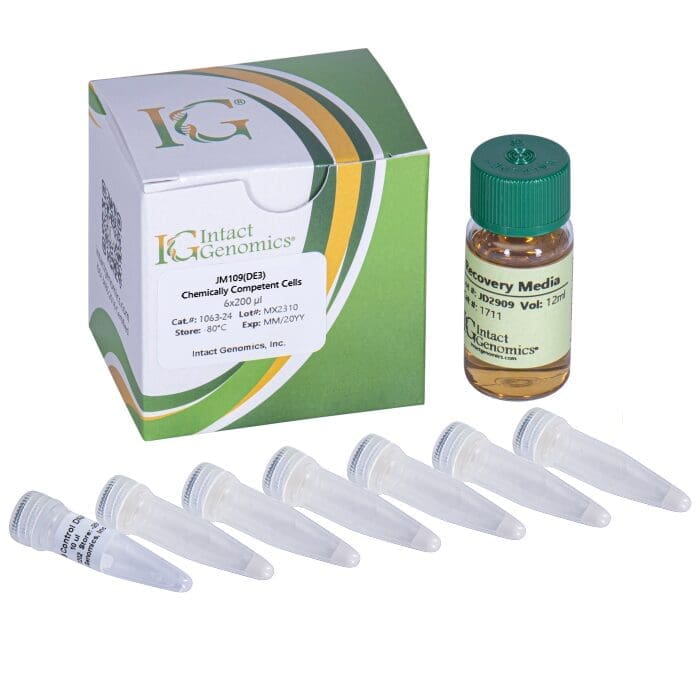
Intact Genomics JM109-DE3 chemically competent E. coli cells are suitable for high-efficiency transformation in a wide variety of applications such as cloning and sub-cloning. JM109-DE3 is useful for the high-level expression of genes cloned into vectors for the expression of sequence downstream from the T7 promoter.
Specifications
Competent cell type: Chemically Competent
Derivative of: JM109
Species: E. coli
Format: Tubes
Transformation efficiency: ≥1.0 x 10⁸ cfu/µg pUC19 DNA
Blue/white screening: No
Shipping condition: Dry ice
Product Includes & Storage
1) ig™ JM109(DE3) competent cells: -80 ºC
2) pUC19 control DNA: -20 ºC
3) Recovery medium: 4 ºC
Genomic Features
ig™ JM109-DE3 chemically competent cells have the following features:
- recA– and endA– to minimize recombination and improve the quality of plasmid DNA.
Genotype
endA1, recA1, gyrA96, thi, hsdR17 (rk–, mk ), relA1, supE44, λ-, Δ(lac–proAB), [F’ traD36, proAB, laqIqZΔM15], IDE3
Quality Control
Transformation efficiency is tested by using the pUC19 control DNA supplied with the kit and the high-efficiency transformation protocol listed below. Transformation efficiency should be ≥1 x 10⁸ CFU/µg pUC19 DNA.
Technical Support
Intact Genomics is committed to supporting the worldwide scientific research community by supplying the highest quality reagents. Each new lot of our products is tested to ensure they meet the quality standards and specifications designated for the product. Please follow the instructions carefully and contact us if additional assistance is needed. We appreciate your business and your feedback regarding the performance of our products in your applications.
Protocol
Use this procedure to transform JM109(DE3) Chemically Competent Cells. We recommend verifying the transformation efficiency of the cells using the pUC19 control DNA supplied with the kit. Do not use these cells for electroporation.
1. Remove competent cells from the -80 °C freezer and thaw completely on wet ice (10-15 minutes).
2. Aliquot 1-5 µl (1 pg-100 ng) of DNA to the chilled microcentrifuge tubes on ice.
3. When the cells are thawed, add 50 μl of cells to each DNA tube on ice and mix gently by tapping 4-5 times. For the pUC19 control, add 1 µl of (10 pg/µl) DNA to a chilled microcentrifuge tube, prior to adding 50 µl of Mix well by tapping. Do not pipette up and down or vortex to mix, this can harm cells and decrease transformation efficiency.
4. Incubate the cells with DNA on ice for 30 minutes.
5. After 30 minute ice incubation, heat shock the cells at 42 °C for 45 seconds.
6. Transfer the tubes to ice for 2 minutes.
7. Add 950 µl of Recovery Medium or any other medium of choice to each tube.
8. Incubate tubes at 37 °C for 1 hour at 210 rpm.
9. Spread 50 μl to 200 μl from each transformation on
10. Pre-warmed selection plates. We recommend plating two different volumes to ensure that at least one plate will have well-spaced colonies. For the pUC19 control, plate 50 μl on an LB plate containing 100 μg/ml ampicillin. Use sterilized spreader or autoclaved ColiRoller™ plating beads to spread evenly.
11. Incubate the plates overnight at 37 °C.
5 Minute Transformation Protocol
The following procedure results in only ~10% of the transformation efficiency as the protocol listed above.
1. Remove competent cells from the -80 °C freezer and thaw in your hand.
2. Aliquot 1-5 µl (1 pg-100 ng) of DNA to the microcentrifuge tubes. Do not pipette up and down or vortex to mix, this can harm cells and decrease transformation efficiency.
3. Incubate the cells with DNA on ice for 2 minutes.
4. After 2-minute ice incubation, heat shock the cells at 42 °C for 45 seconds.
5. Transfer the tubes to ice for 2 minutes.
6. Add 950 µl of Recovery Medium at room temperature or any other medium of choice to each tube. Immediately spread 50 μl to 200 μl from each transformation on pre-warmed selection plates. We recommend plating two different volumes to ensure that at least one plate will have well-spaced colonies. For the pUC19 control, plate 50 μl on an LB plate containing 100 μg/ml ampicillin. Use sterilized spreader or autoclaved ColiRoller™ plating beads to spread evenly.
7. Incubate the plates overnight at 37 °C.
Downloads
Manual – JM109(DE3) Chemically Competent Cells
MSDS – JM109(DE3) Chemically Competent Cells
If you cannot find the answer to your problem then please contact us or telephone +44 (0)1954 210 200