Important Information:
EP 2.6.7 update: key changes in mycoplasma testing and how to meet new requirements
Updated Mar 4, 2026 (Nov 7, 2025) | Informative Articles
PDF version available here

Featured in this article:
Section 1: Regulatory framework - EP 2.6.7 (Edition 12.2)
Section 2: New product portfolio
Section 3: Comparison old vs. new products and transition strategy
Section 4: Validation and method suitability
A revised version of European Pharmacopoeia (EP) chapter 2.6.7
entered into force on April 1, 2026. This revision establishes, for the
first time, a clear regulatory framework for NAT-based mycoplasma
detection methods (e.g. PCR, qPCR, dPCR) as standalone assays.
Recognising the specific challenges of ATMPs—such
as cell-containing matrices, complex manufacturing processes, limited
sample volumes and high matrix variability—the revised chapter
explicitly allows NAT methods as equivalent alternatives to culture and
indicator cell methods, provided appropriate validation and
product-specific suitability testing are performed.
The chapter also further specifies requirements
for mycoplasma reference standards and now explicitly includes genome
copy (GC)-based standards alongside traditional CFU-based standards. A
key addition is the “test for inhibitory substances,” ensuring that the
product matrix does not interfere with the NAT assay and that the
required sensitivity is achieved under real conditions.
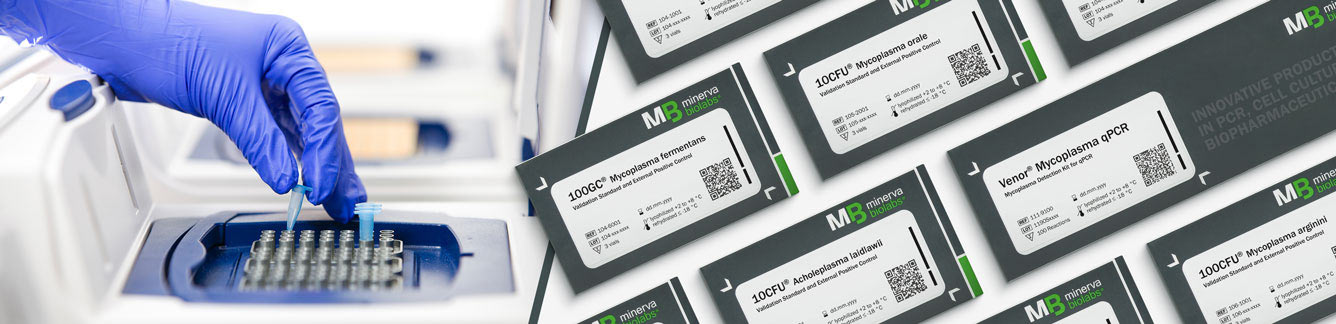
To address these requirements, Minerva Biolabs developed a coordinated system comprising the Venor® Mycoplasma PCR assays, the Venor® Mycoplasma Extraction kit, and the 100GC®, 10CFU® and 100CFU® Mycoplasma Standards.
This document summarizes the key regulatory
updates, outlines Minerva Biolabs’ adapted product portfolio, and
provides guidance on implementing and validating NAT-based mycoplasma
testing in accordance with EP 2.6.7.
1.1 What has changed with the EP 2.6.7 (12.2)?
- The requirements for mycoplasma material used for validation studies has been further specified, in particular:
- Colony forming units (CFU) must be determined at the time of harvest, without prior freezing of the culture.
- The ratio of genome copies to colony forming units (GC/CFU) must not exceed 10.
- Genomic copies are mentioned for the first
time. A LOD of < 100 GC/ml has been added as acceptable sensitivity
alongside the LOD of ≤10 CFU/ml. Therefore, reference standards may
consist of native mycoplasmas (CFU) or nucleic acids (GC).
- Product- or matrix-specific suitability
testing is clearly defined (referred to in the EP as the “test for
inhibitory substances”).
- Testing of both cells and supernatants is recommended whenever possible.
- Clearly defined controls are required, including an external positive control.
1.2 Can PCR replace the culture method?
Yes. NAT-based methods (e.g. PCR, qPCR, dPCR) can
replace the culture method and/or the indicator cell culture method,
provided they are validated in accordance with EP 2.6.7.
During the manufacturer’s validation of our
mycoplasma PCR kits, viable mycoplasma spike material was used. The
comparison with viable material has therefore already been established.
The user only needs to perform a product-specific validation (see Section 4. for further details).
1.3 What are the new LOD requirements?
The limit of detection (LOD) is clearly defined as ≤10 CFU/ml or <100 GC/ml.
1.4 What is the “test for inhibitory substances”?
The term “test for inhibitory substances” means
the same as „matrix-specific validation“, „product-specific validation“
or „method suitability test“.
All of these terms describe the same regulatory
concept: demonstrating that the product matrix does not inhibit the NAT
method and that the required sensitivity is achieved in the presence of
the product.
1.5 What is the “external positive control”?
The external positive control (EPC) is an
additional positive control used independently of the detection kit.
According to EP 2.6.7 (12.2), it must contain a defined number of
target-sequence copies or CFUs and is set close to the cut-off, to
demonstrate that the validated sensitivity is achieved.
Minerva Biolabs´ mycoplasma detection kits only
contain an internal control and an internal positive control. The EPC is
not included in our mycoplasma PCR detection kits. For EPC we recommend
to use 100GC® or 100CFU® Mycoplasma Standards.
2.1 Overview of new EP-compliant portfolio
2.1.1 Which components are required for EP 2.6.7 (12.2) compliant NAT testing?
For EP 2.6.7 compliant use of a NAT-based mycoplasma test, the following components are typically required:
- A validated mycoplasma PCR assay, including an internal control and a positive control, e.g. Venor® Mycoplasma qPCR or Venor® Mycoplasma dPCR.
- A mycoplasma extraction kit to isolate DNA and RNA for sample purification and reduction of potential PCR inhibitors, e.g. Venor® Mycoplasma Extraction kit.
- Mycoplasma standards for sensitivity determination and as external positive control, e.g. 100GC® Mycoplasma Standards, 10CFU® Mycoplasma Standards or 100CFU® Mycoplasma Standards.
2.1.2 Can the new Venor® Mycoplasma PCR assays be used for new validations according to EP 2.6.7 (12.2)?
Yes. Venor® Mycoplasma PCR assays can be used for new validations as well as re-validations according to EP 2.6.7.
2.2 Why were new mycoplasma standards and PCR kits introduced?
2.2.1 The critical role of mycoplasma reference material
The performance evaluation of a NAT-based
Mycoplasma assay according to EP 2.6.7 requires the use of
well-characterized mycoplasma suspensions of defined concentration.
Validation is performed by spiking the relevant sample matrices with
known quantities of mycoplasma organisms.
Consequently, the validity and interpretability
of the entire assay validation are directly dependent on the quality and
correct characterization of the spike material used. Any inaccuracy in
the preparation or quantification of this material would directly impact
the assessment of assay performance.
This is why the preparation and characterization
of compliant mycoplasma material represents the most critical and
technically demanding part of the validation processes.
2.2.2 Production and characterization of former 10CFU®/100CFU® Sensitivity Standards
Minerva Biolabs’ 10CFU®/100CFU® Sensitivity
Standards were developed in accordance with the best scientific
knowledge available at the time, outlined in EP 2.6.7 (01/2008). These
standards are fully compliant with the EP 2.6.7 (editions 6.1-12.1).
Genome copy number (GC) is determined using a
quantitative PCR (qPCR) assay validated against the culture method. The
target Ct value used for quality control is derived from the average
value observed during kit validation with viable mycoplasmas at a
concentration of 10 CFU/ml. Only the Ct value is used as release
criteria. The standards are manufactured and tested to achieve Ct values
comparable to those obtained during initial validation with viable
mycoplasmas.
At customer’s requests, a GC/CFU ratio was
determined using the state-of-the-art methodology available at the time,
applying linear regression following photometric quantification of the
calibrator in qPCR, although no regulatory requirement was in place.
The native material used to produce the former
10CFU®/100CFU® Sensitivity Standards was harvested in the exponential
growth phase and subsequently diluted down to a target concentration of
10 CFU/ml. Although dilutions were performed assuming theoretical
linearity, this linearity could never be verified in practice. Dilution
errors — whether systematic or random — cannot be identified
retrospectively based on plating results. In addition, mycoplasma
species may exhibit aggregation or clustering behavior, further
complicating homogeneous dilution.
2.2.3 Regulatory considerations
With the most recent revision of the EP 2.6.7
(12.2), the requirements for mycoplasma material used in validation
studies have been specified, in particular:
- Colony forming units (CFU) must be determined at the time of harvest, without prior freezing of the culture.
- The ratio of genome copies to colony forming units (GC/CFU) must not exceed 10.
- LOD of < 100 GC/ml has been added as acceptable sensitivity alongside the LOD of ≤10 CFU/ml.
These requirements are intended to ensure that
the material used for validation appropriately reflects viable organisms
and does not contain disproportionately high amounts of amplifiable
nucleic acid that could potentially lead to an overestimation of assay
sensitivity.
2.2.4 Use of emerging technologies
To establish compliance with the GC/CFU
requirement, genome copy numbers must be determined. The EP does not
prescribe a specific methodology for genome copy quantification. Various
approaches are scientifically justifiable. For the validation of our
kits, digital PCR (dPCR) was selected as the quantification method of
choice. This decision reflects our interpretation of the regulatory
intention to avoid the use of material containing excessive amounts of
amplifiable nucleic acid relative to viable organisms.
Digital PCR, enabling absolute quantification,
may yield GC/CFU ratios that differ from those obtained using
traditional methods. These deviations are typically attributable to
mycoplasma aggregates, which may not be thoroughly dispersed by sample
processing techniques such as sonication or vortexing. In the culture
method, a single agglomerate forms only one colony, but it contains an
unpredictable number of mycoplasma cells, which break up during sample
preparation in NAT assays, each generating one GC (Ackermann et al.,
2019, Journal of Microbiological Methods, 165).
Absolute quantification by dPCR demonstrated that
the assigned values of the former 10CFU®/100CFU® Sensitivity Standards
were overestimated.
2.2.5 Updated mycoplasma standard portfolio
In response to the revised EP 2.6.7 and to
maintain methodological state-of-the-art alignment, Minerva Biolabs
developed new mycoplasma standards covering all relevant species in
accordance with the updated requirements.
For the production of the new standards, enhanced
control measures were implemented. Amongst others, the mycoplasma
material was absolutely quantified using dPCR. In addition, extracts of
the dilutions used for CFU enumeration were analysed by qPCR. This
analysis was not used for absolute quantification but served to evaluate
dilution linearity and to detect potential systematic or random
dilution errors.
With the implementation of dPCR technology, the
new standards could be calibrated with significantly greater precision,
resulting in improved alignment between culture-based and NAT-based
results.
These standards are characterized as follows:
- Manufactured from native mycoplasma material
- Absolute quantification by validated dPCR (QC release criterion)
- Defined GC/CFU ratio < 10 in accordance with EP 2.6.7 (12.2), documented in the CoA
- Optimized cultivation and improved dispersion (reduced cluster formation)
- Characterization in both CFU and GC in line with the requirements of the revised EP
- Gentle, proprietary inactivation process (replacing former heat inactivation)
- Preservation of stable DNA/RNA Mycoplasma Standards to support NAT and RT-NAT methods
- Manufacturing process based on precisely defined master batches in accordance with new regulatory expectations
The new standards are suitable for method validation, re-validation and future regulatory applications.
2.2.6 Updated mycoplasma PCR assay portfolio
Due to the updated requirements on the
preparation of the new 10CFU®, 100CFU® und 100GC® Mycoplasma Standards,
the sensitivity of DNA-based PCR assays (Venor®GeM Classic and Venor®GeM
qEP) was no longer adequate to reliably detect 10 CFU/ml or 100 GC/ml.
Consequently, new PCR kits featuring combined DNA and RNA detection
through reverse transcriptase (RT) technology were developed:
The new PCR kits were manufactured in accordance
with EP 2.6.7 (12.2) and are aligned with RT-PCR technology, providing
an improved sensitivity and robustness in the range of 10 CFU/ml and 100
GC/ml.
3.1 PCR detection kits
3.1.1 Why are the new Venor®
Mycoplasma PCR kits reverse transcriptase assays (detection of RNA)? Are
there any regulatory requirements?
No, detection of RNA and DNA (reverse transcriptase PCR; RT-PCR) is not a regulatory requirement.
With the new Mycoplasma Standards,
developed in accordance with the updated requirements for reference
material preparation, the required sensitivity and robustness can only
be achieved by detecting both DNA and RNA using RT-PCR.
3.1.2 Can existing authority-approved systems (Venor®GeM qEP / Venor®GeM Classic) continue to be used?
Venor®GeM qEP or Venor®GeM Classic remain
available until April 2029 and may continue to be used for existing,
authority-approved applications.
We currently have no generally applicable,
officially binding statement that stipulates that existing validations
must be revalidated after EP 2.6.7 (12.2) comes into force.
Our interpretation is as follows: Validations
carried out under EP 2.6.7 (01/2008) remain valid within the scope of
the regulatory requirements applicable at that time. Existing
validations are not automatically invalidated retroactively. Whether
revalidation or verification is required is a case-specific issue and
depends on the authority, country, product, and risk assessment.
We recommend discussing this with your local
authority and planning to switch to the new Venor® Mycoplasma PCR
product line by the end of April 2029.
3.1.3 How long will the older kits Venor®GeM qEP / Venor®GeM Classic remain available?
Until end of April 2029.
3.1.4 Why is it recommended to switch to the new Venor® Mycoplasma PCR assays?
A transition to the new Venor® Mycoplasma PCR assays is particularly recommended when:
- New validations or re-validations according to EP 2.6.7 (12.2) are performed.
- Significant changes to the method, product matrix or reference standards are planned.
- Unstable or borderline results are observed with older PCR assays.
- New EP-compliant Mycoplasma Standards are to be implemented.
-
3.1.5 Do the new Venor® Mycoplasma PCR assays come with a manufacturers validation?
Yes. Venor® Mycoplasma PCR assay and Venor®
Mycoplasma Extraction kit has extensively been validated together.
Sensitivity, specificity and robustness are covered in the validation
report, that is available on request. During the manufacturers
validation, viable mycoplasma spike material was used. The comparison
with viable material has therefore already been established. The user
only needs to perform a product-specific validation (see section 4 for
further details).
3.1.6 Can the older kits Venor®GeM qEP / Venor®GeM Classic be used for new validations in accordance with EP 2.6.7 (12.2)?
For new method validations or re-validations
according to EP 2.6.7 (Edition 12.2), we recommend using the new Venor®
Mycoplasma assays. Venor®GeM qEP and Venor®GeM Classic are not intended
for this purpose.
3.2 Mycoplasma Standards (100GC®, 10CFU®, 100CFU®)
3.2.1 Are previous 10CFU®/100CFU® Sensitivity Standards still EP-compliant with Edition 12.2?
No. The previous 10CFU®/100CFU® Sensitivity
Standards will no longer meet the revised regulatory requirements. The
new EP (12.2) provides direct guidelines for the production of reference
materials, forming the basis for the development of the new
10CFU®/100CFU® Mycoplasma standards. For details, please refer to point
2.2.
10CFU®/100CFU® Sensitivity Standards are only compliant with the EP 2.6.7 (editions 6.1-12.1).
3.2.2 How long will the older 10CFU®/100CFU® Sensitivity Standards remain available?
The 10CFU®/100CFU® Sensitivity Standards remain available until the end of April 2029.
3.2.3 We are concerned if RNA may be degraded under 2–8 °C. What is the shelf life of the new standards?
Shelf lives were assigned based on experience and
risk assessment: 18 months for the 100GC® Mycoplasma Standards and 12
months for the 10CFU® and 100CFU® Mycoplasma Standards, when stored in
lyophilized form at 2–8 °C. After rehydration, the standards must be
used immediately. Stability studies are ongoing.
Please subscribe to our
Notification of Change (https://minerva-biolabs.com/en/#mb_noc) to stay informed about any updates to the shelf life.
3.2.4 Can both 10CFU® Mycoplasma Standards and 100GC® Mycoplasma Standards be used for EP-compliant validation?
Yes. EP 2.6.7 (12.2) explicitly allows ≤ 10 CFU/ml or < 100 GC/ml. Both units are regulatorily acceptable.
3.2.5 Why are 100GC® Mycoplasma Standards recommended for NAT-based methods?
10CFU® Standards are regulatorily acceptable
under EP 2.6.7. However, 100GC® Standards are the more appropriate
choice for NAT-based validation for the following reasons:
- NAT assays measure nucleic acids regardless
of whether mycoplasmas are viable, making GC the more appropriate unit
for molecular assays.
- CFU originates from culture-based methods
and reflects colony-forming capability, whereas GC ensures clearer
interpretation and comparability of PCR results.
- In inactivated materials, colony formation
is no longer possible, so CFU values can only be assigned indirectly,
while GC remains analytically valid and independent of culturability.
Furthermore, a level of 100 GC corresponds to the
highest possible titer (assuming a maximum GC/CFU ratio of 10) and thus
represents the most favorable scenario for validation. CFU-based
materials, however, pose a greater challenge.
3.2.6 Can the previous 10CFU®/100CFU® Sensitivity Standards be used with the new Venor® Mycoplasma PCR assays?
In principle, yes. However, this is not advisable in light of the revised EP 2.6.7 (12.2).
The previous 10CFU®/100CFU® Sensitivity Standards
were not manufactured in accordance with the revised EP. They are
therefore not recommended for new method validations or re-validations
under the updated guideline. They may still be used for existing
applications, transition phases, or comparative studies.
For EP-compliant new validations, the use of
100GC®, 10CFU® or 100CFU® Mycoplasma Standards is mandatory, as these
have been characterized in accordance with EP 2.6.7 (12.2) and are
aligned with the new Venor® Mycoplasma assays.
3.2.7 Can the new 10CFU®, 100CFU® or 100GC® Mycoplasma Standards be used with the older Venor®GeM qEP & Venor®GeM Classic?
In principle, yes. However, this is not
advisable. The new 100GC® and 10CFU® Mycoplasma Standards were not
validated together with Venor®GeM qEP and Venor®GeM Classic and cannot
be robustly detected.
3.3 Nucleic acid extraction
3.3.1 What is the difference between the Venor® Mycoplasma Extraction kit and Venor®GeM Sample Preparation Kit?
Compared to the Venor®GeM Sample Preparation Kit
(spin column based), the Venor® Mycoplasma Extraction Kit (magnetic bead
based) offers the following advantages:
- Validated in combination with the new Venor® Mycoplasma PCR assays
- Extraction of both DNA and RNA
- Higher extraction efficiency
- Higher method robustness and reproducibility
- Improved compatibility with complex sample matrices
- Proteinase K included in the kit
- Manual or automated processing (e.g. using extraction instruments) possible
3.3.2 Must the Venor® Mycoplasma Extraction kit be used, or is Venor®GeM Sample Preparation Kit still permitted?
EP 2.6.7 does not require a specific extraction
kit. For the use of Venor® Mycoplasma PCR assays, it is essential that
DNA and RNA are reliably extracted, relevant inhibition is avoided, and
the required sensitivity is achieved. The Venor® Mycoplasma Extraction
kit is strongly recommended, as it was validated together with the
Venor® Mycoplasma PCR assays and provides robust and reproducible
performance. The Venor®GeM Sample Preparation Kit may in principle be
used, but was not validated together with the Venor® Mycoplasma PCR
assays and therefore requires full user-side verification.
3.3.3 Is an extraction step mandatory under EP 2.6.7?
EP 2.6.7 describes extraction as part of the analytical procedure, particularly for NAT-based methods.
In practice, when using NAT based detection
methods, DNA and RNA extraction is strongly recommended and often
necessary, because:
- Both cells and supernatants should be tested whenever possible
- RNases and DNases may be present in the product matrix
- PCR inhibition occurs more frequently without extraction
- The required sensitivity is often not reliably achieved without extraction.
3.3.4 Can the Venor®GeM Sample Preparation Kit in principle extract RNA?
In principle, Venor®GeM Sample Preparation Kit is
also able to extract RNA. But there are no internally validated data
confirming that the Venor®GeM Sample Preparation Kit provides RNA
extraction of sufficient quality and quantity for use with the Venor®
Mycoplasma PCR assays. For this reason, its use is not recommended.
Furthermore, due to the advantages of the Venor®
Mycoplasma Extraction Kit (refer to point 3.3.1) and for a robust,
validated workflow in regulated environments, we recommend using the
Venor® Mycoplasma Extraction Kit.
4.1 Which test do I need to perform as a user before I can proceed with routine testing?
You only have to perform product-specific
suitability test (referred to in the EP as the “test for inhibitory
substances”). For this purpose, we recommend our new mycoplasma
standards.
4.2 What should the experimental setup look like for the test of inhibitory substances (product-specific validation)?
EP 2.6.7 describes, among others, the following acceptable approach:
- Spiking selected mycoplasma species at a defined level (e.g. <100 GC/ml or ≤10 CFU/ml)
- 5 replicates per batch
- 3 different batches
- All replicates must be positive
In the presence of the product, the cut-off must
not exceed the required sensitivity. Alternative approaches are
acceptable, provided the rationale and acceptance criteria are
documented.
4.3 Which mycoplasma species should be selected for EP-2.6.7-compliant validation?
EP 2.6.7 (12.2) defines suitable mycoplasma
species based on contamination frequency and phylogenetic relevance.
Listed species include:
- Acholeplasma laidlawii
- Mycoplasma fermentans
- Mycoplasma hyorhinis
- Mycoplasma orale
- Mycoplasma pneumoniae
- Mycoplasma arginini
- Mycoplasma salivarium
- Mycoplasma gallisepticum (relevant for avian materials)
- Mycoplasma synoviae (relevant for avian materials)
- Spiroplasma citri or another Spiroplasma species (relevant for insect or plant materials)
Not all species must be tested. The chapter
requires a risk-based selection, considering the manufacturing process
(e.g. mammalian, avian or insect materials), the product category (e.g.
biopharmaceuticals, ATMPs, vaccines) and known contamination risks
(literature or process history).
In practice, 3-5 relevant species are typically
selected to support EP-compliant validation or product-specific
suitability testing.
For technical support Please contact support@cambio.co.uk