- Create variable 3’ poly(A) tail lengths from 50 to >300 A’s through post-transcriptional tailing.
- Generate longer poly(A) tails than lengths possible using template-encoded tails.
- Synthesis of long (300 A) tail lengths is possible for increased mRNA stability and translation.
- Simplified workflow with direct input of capped RNA from ScriptCap™ reactions with no cleanup required.
Product is for research use only (RUO)
Product Description: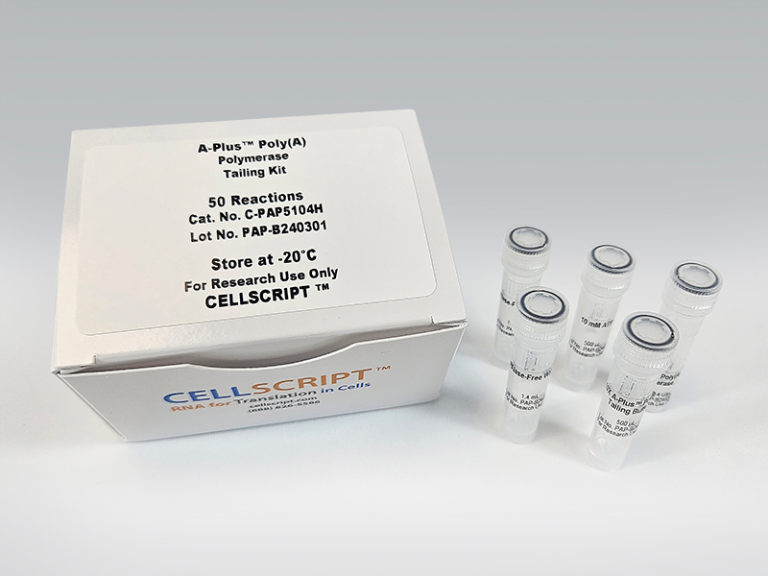
The A-Plus™ Poly(A) Polymerase Tailing Kit uses ATP as a substrate
for template-independent post-transcriptional addition of 3’-poly(A)
tails to RNA. The standard protocol produces a poly(A) tail length of
~150 A’s on 60 µg of RNA in just one hour. However, the flexible
protocol allows users to define their desired poly(A) tail length from
50–300 A’s using straightforward modifications. In this way, poly(A)
tail lengths can be generated much longer than is possible using a
template-encoded tail. Completed ScriptCap™ Cap 1 Capping System
capping reactions can be added directly to the A-Plus™ poly(A) tailing
reaction without cleanup for seamless synthesis of fully 5’-capped and
3’-tailed mRNA.
Polyadenylation increases the stability of RNA in eukaryotic cells
and enhances its ability to be translated after transfection or
microinjection. A poly(A) tail is useful to provide a priming site for
first-strand cDNA synthesis in certain applications and can be used to
end-label or quantify mRNA.
PDF
The nuts and bolts of translational efficiency and the "closed-loop" model
Performance Data:
Poly(A) Tail Length
The standard protocol generates poly(A) tails approximately 150 b
long. Assuming all other reaction parameters remain constant, poly(A)
tail length increases with the following parameter changes:
- Increasing units of A-Plus™ Poly(A) Polymerase
- Increasing incubation time
- Increasing enzyme to substrate ratio
- Decreasing total reaction volume
To find the best reaction conditions for the desired poly(A)-tail
length, set-up several test reactions covering a range of the changing
parameter (Figure 1).
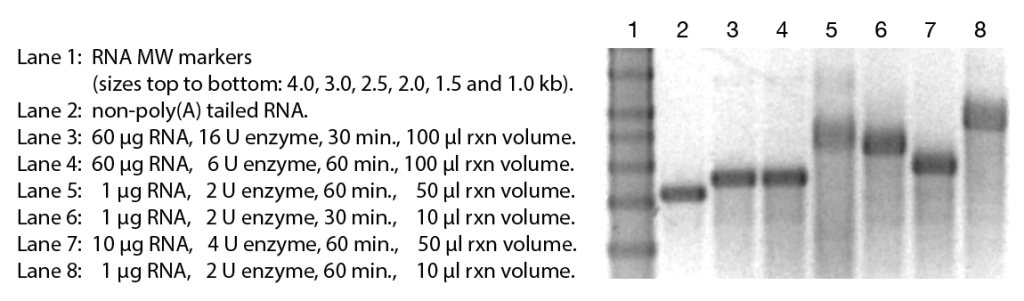
Figure 1. Different poly(A) tail lengths generated
using the A-Plus™ Poly(A) Polymerase Tailing Kit. The standard reaction
results in a poly(A) tail length of approximately 150 bases, but longer
tail lengths can be achieved by adjusting enzyme concentration,
incubation time, RNA input, and reaction volume.
MATERIALS
Materials Supplied
Store at –20°C in a freezer without a defrost cycle. Do not store at –70°C.
| A-Plus™ Poly(A) Polymerase Tailing Kit Contents (50 reactions) |
| Kit Component |
Volume |
A-Plus™ Poly(A) Polymerase, 4 U/μl
in 50% glycerol, 50 mM Tris-HCl, pH 7.5, 0.5 M NaCl, 1 mM
dithiothreitol (DTT) and 0.1 mM EDTA. |
100 μl |
10X A-Plus™ Poly(A) Tailing Buffer
0.5 M Tris-HCl, pH 8.0, 2.5 M NaCl and 100 mM MgCl2. |
500 μl |
| 10 mM ATP |
500 μl |
| RNase-Free Water |
2 x 1.4 ml |
Materials Required, but not Supplied
• Materials or kits for purification of the RNA product. (For suggestions, see RNA Purification, page 4)
• RNase-free TE Buffer (10 mM Tris-HCl, pH 7.5, 1 mM EDTA)
• Optional: TE saturated phenol/chloroform, 0.5-1 M EDTA, ScriptGuard™ RNase Inhibitor
SPECIFICATIONS
Unit Definition
One unit of A-Plus Poly(A) Polymerase converts 1 nmole of ATP into acid-insoluble material in 10
minutes at 37oC under standard assay reaction conditions.
Functional Testing
The A-Plus Poly(A) Polymerase Tailing Kit is functionally tested in 1X A-Plus Poly(A) Tailing Buffer
with 1 mM ATP, a 1.4 kb RNA transcript and varying amounts of A-Plus Poly(A) Polymerase.
Contaminating Activity Assays
All components of the A-Plus Poly(A) Polymerase Tailing Kit are free of detectable RNase and DNase
activity.
If you cannot find the answer to your problem then please contact us or telephone +44 (0)1954 210 200