- Extremely active at high temperatures (55 °C to 80 °C): Improves specificity of cDNA Synthesis from diverse RNA templates
- Sensitive: Detects 100 copies of RNA in two-step RT-qPCR assays
- Short reaction time (5 minutes or less): Streamlined RT-qPCR workflow and faster time to results
- Stable at room temperature (> 3 months): Simplifies setup on
automation decks (no cold storage required) and enables use in
environments with limited cold-storage
- Lyo-compatible: Enzyme formulation is free of glycerol -and other
components- that are known to interfere with downstream lyophilisation
- Batch to batch reproducibility: Manufactured in an ISO 13485-certified facility
RapiDxFire Thermostable Reverse Transcriptase is a significant
advancement over popular MMLV- and AMV reverse transcriptases.
Originally identified in hot springs, this robust bacteriophage enzyme
exhibits increasingly high activity at elevated temperatures (~60%
activity remains after 10 min at 90 °C) and maintains its core activity
after >3 months storage at 20-25°C. This enzyme lacks RNAse H and 3’
5’ exonuclease activity and efficiently synthesises short cDNA
fragments (≤ 1 Kb). Like other reverse transcriptases, RapiDxFire RT
possesses DNA polymerase activity but lacks 5′ 3′
exonuclease activity. Supplied in a glycerol-free, Triton™ X-100-free
storage buffer, the enzyme formulation can be further optimised for
downstream lyophilisation.
RapiDxFire Thermostable RT Performs Best at High Temperatures
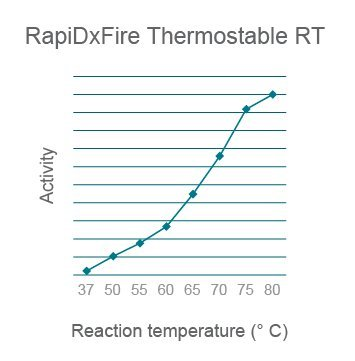
Figure 1. Reaction temperature profile for RapiDxFire Thermostable Reverse Transcriptase.
Reverse transcription reactions were set up on ice using each
manufacturer’s recommended buffer system and Poly (rC) /p(dG)12-18
template/primer substrate. Reactions were transferred from ice to the
indicated temperatures (37, 50, 55, 60, 65, 70, 75, and 80 °C) and
incubated for 40 minutes. Following incubation, RNA/cDNA heteroduplex
product is quantified as a measure of polymerisation activity, utilising
PicoGreen® fluorescence on a Tecan Infinite® M1000 Pro. RapiDxFire
Thermostable RT exhibits increasing activity as the reaction temperature
is increased, up to 80 °C (highest temperature tested); ~60% activity
remains after 10 min at 90 °C (data not shown).
Superior Detection of Zika virus with RapiDxFire Thermostable RT
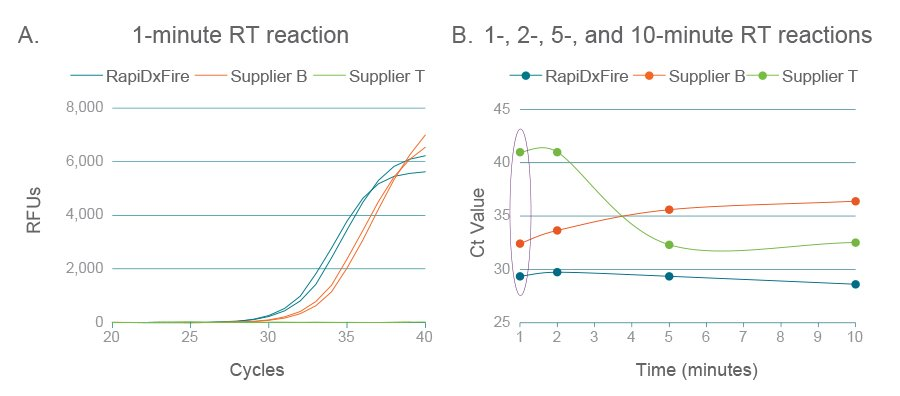
Figure 2. cDNA synthesis time course studies in a 2-step RT-qPCR reaction with different thermostable RTs.
A) qPCR curve after a 1 minute reverse transcription reaction. Zika
cDNA synthesis was conducted for each enzyme in duplicate using
target-specific primers and recommended reaction buffer and incubation
temperatures per suppliers’ guidelines (RapiDxFire= 60 °C, Supplier B=
50 °C, and Supplier T= 55 °C). After cDNA synthesis real time PCR was
performed using one-tenth volume of each of the cDNA samples. PCR was
performed using EconoTaq and its supplied buffer (Item No. 30031-3).
Detection of PCR products were done real time using an intercalating dye
(Dyomics Cat No. V13-01184) and BioRad CFX C1000 Touch™ with
absorption/emission of 481nm/526nm. B) Reverse transcription time course
study prior to performing second-step real-time PCR. Encircled data
points are derived from data represented in the qPCR curve in A).
3-month Room Temperature Stability
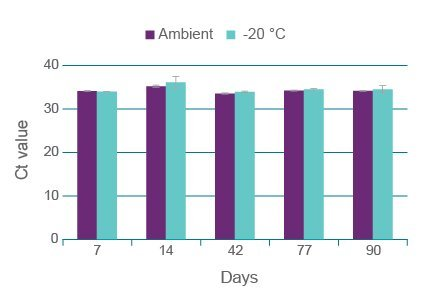
Figure 3. RapiDxFire Thermostable RT was stored in separate aliquots per time point at ambient and -20 °C.
At each time point RapiDxFire Thermostable RT was evaluated by
measuring first-strand cDNA synthesis of 10000 copies MS2 RNA. cDNA
synthesis was carried out using a gene-specific primer for MS2 at
reaction temperature of 60 °C for 5 minutes. cDNA was measured using
real time PCR and MS2 primers design around a 520 base pair amplicon.
Legal Information/Updates:
US Patent 8093030 for RapiDxFire™ is owned by LGC, Biosearch
Technologies. For research use only. Not for use in diagnostic
procedures.
- Storage: Store at -20 °C.
- Storage Buffer: RapiDxFire Thermostable RT is supplied in a glycerol-free, Triton X-100-free buffer.
- Unit Definition: One RT unit is defined as the
amount of enzyme required to incorporate 1 nmol of dTTP into an
acid-insoluble form in 10 minutes at 55 °C (using poly(rA) oligo(dT) as
template primer and 1X kit -supplied buffer formulation).
- Functional QC Assay: RapiDxFire Thermostable RT is
functionally tested with gene-° primer and bacteriophage MS2 RNA. In
this reaction the enzyme converts 1000 copies of MS2 RNA into 520 bp
cDNA in 5 minutes at 60 °C.
- Endonuclease: Free of contaminating endonucleases at the 10 Unit level.
- Exonuclease: Free of contaminating exonucleases at the 10 Unit level.
- RNase Activity: No RNase activity detected using a fluorescence-based RNase activity assay.
SDS
Manuals and user guides