-
Powerful strand displacement activity, making it ideal for challenging samples or damaged DNA
-
Highly processive, allowing for amplification of up to 70,000 base insertions per binding event
-
High-fidelity 3'->5' proofreading exonuclease function for accurate DNA replication with low error rates
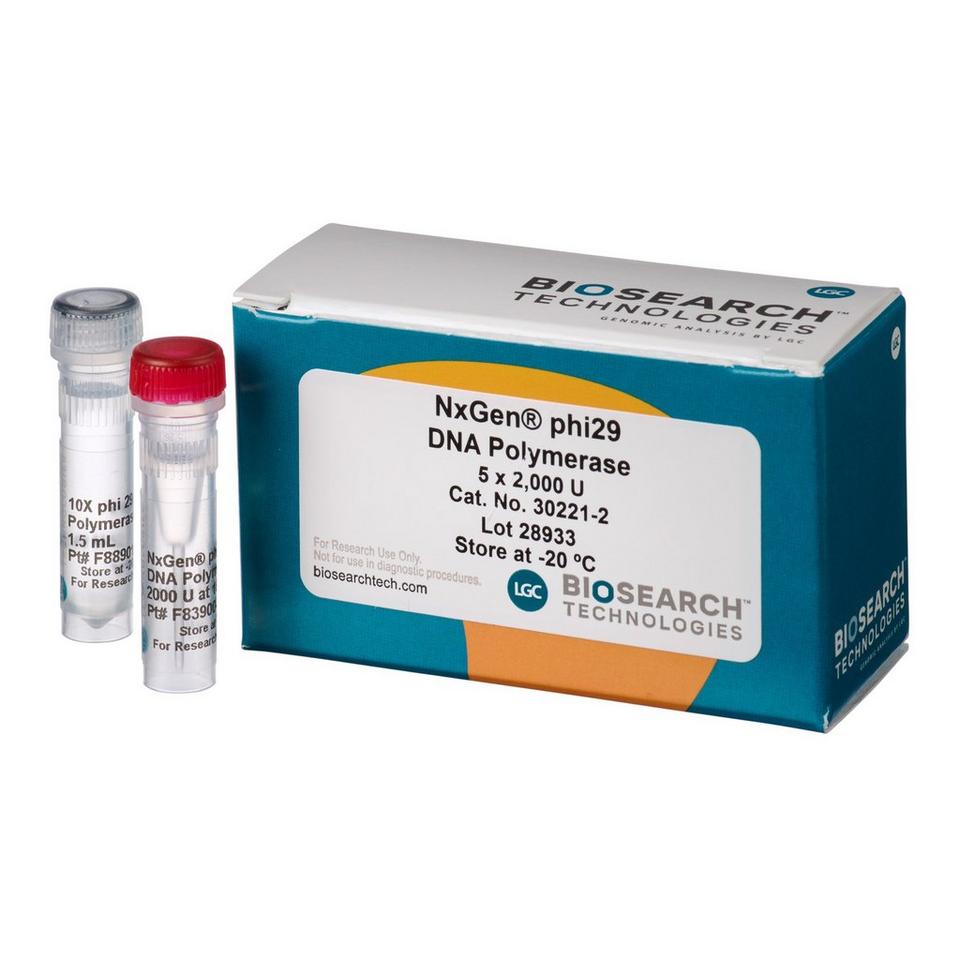
The NxGen Phi29 DNA Polymerase sources its enzyme from a recombinant E. coli strain carrying the phi29 DNA polymerase gene from bacteriophage phi29.
1 unit is defined as the amount of polymerase required to convert 0.5
pmol of dNTP's into acid insoluble material in 10 minutes at 30 °C.
The enzyme storage buffer consists of 10 mM Tris-HCl, 100 mM KCl, 0.1
mM EDTA, 1 mM dithiothreitol, 0.5% Tween-20, 0.5% NP-40, 50% glycerol,
pH 7.4 @ 25 °C and the 10X phi29 DNA Polymerase Buffer is composed of
500 mM Tris-HCl, 100 mM (NH4)2SO4, 40 mM Dithiothreitol, 100 mM MgCl2, pH 7.5 @ 25 °C.
NxGen Phi29 DNA Polymerase is a highly processive, high-fidelity DNA polymerase that is derived from bacteriophage phi29.
It is an isothermal DNA polymerase with high strand displacement
activity and a 3′→ 5′ proofreading exonuclease function that can amplify
DNA with high specificity and accuracy, even from limited or degraded
samples.
Ideal applications:
-
Rolling Circle Amplification (RCA)
-
Whole Genome Amplification (WGA)
-
Strand Displacement Activity
The high processivity of the enzyme allows for efficient
amplification of long DNA fragments up to 70,000 base insertions per
binding event, while the high-fidelity ensures that the amplified DNA is
of high quality and accuracy.

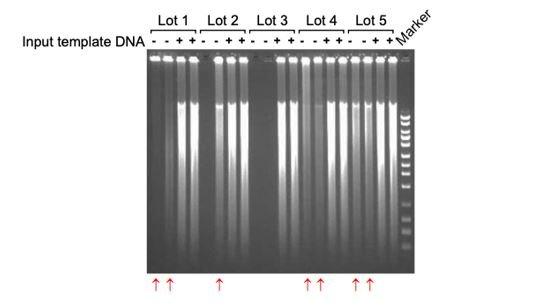
Figure 1. Whole genome amplification as outlined in Protocol 2 of
this manual. Five different lots of NxGen phi29 DNA Polymerase were used
and duplicate NTC and ( ) human genomic amplification reactions were
set up. Amplification reactions were incubated for 16 hours at 30 °C and
products were analysed in a 0.7% agarose gel and stained with ethidium
bromide to visualise amplified DNA. The red arrows indicate NTC
reactions with detectable background (input template independent)
amplification.
Unit Definition: 1 unit is defined as the amount
of polymerase required to convert 0.5 pmol of dNTP's into acid insoluble
material in 10 minutes at 30°C.
Source: A recombinant E. coli strain carrying the phi29 DNA Polymerase gene from bacteriophage phi29.
SDS
Manuals and user guides