Avalanche®-CRISPR Transfection Reagent
One of the most important factors that determines a successful CRISPR-Cas9–mediated genome editing is the efficiency of delivering functional Cas9 and sgRNA into the cells (the transfection process). EZ Biosystems, the transfection and gene expression expert, has specifically designed, and successfully developed a transfection reagent for CRISPR-Cas9 gene editing in mammalian cells —- Avalanche®-CRISPR Transfection Reagent (The Reagent, hereafter) with the maximum possible transfection efficiency.
Description
CRISPR-Cas9 mediated genome targeting:
CRISPR-Cas9 is a genome-editing technology adapted from a natural defense system in bacteria and archaea. In mammalian cells, a single-guide RNA (sgRNA) directs the Cas9 enzyme to a matching DNA sequence next to a compatible PAM sequence. Cas9 cuts the DNA, and the cell’s repair processes can then disrupt or alter the targeted gene.
Researchers use CRISPR-Cas9 to investigate gene function, model genomic changes involved in cancer and other diseases, and explore ways to correct disease-causing mutations. Successful editing depends on delivering the CRISPR components into the target cells and verifying the resulting DNA changes.
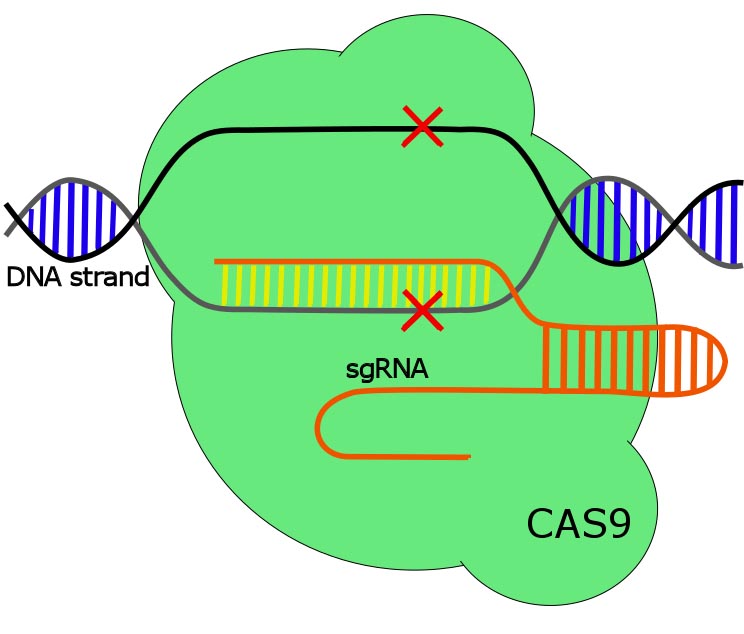
The Cas9 enzyme (green) generates breaks in double-stranded DNA by using its two catalytic centers to cleave each strand of a DNA target site next to a PAM sequence and matching the 20-nucleotide sequence of the single guide RNA (sgRNA).
The Transfection Reagent:
Features:
- Specifically designed for CRISPR-Cas9 gene editing transfection in mammalian cells
- Supports multiple CRISPR-Cas9 delivery formats: plasmid(s) encoding Cas9 and gRNA; a Cas9-encoding plasmid co-delivered with gRNA; Cas9 mRNA co-delivered with gRNA; or a preassembled Cas9–gRNA ribonucleoprotein (RNP) complex.
- Compatible with TrueGuide™ Synthetic gRNA, TrueCut™ Cas9 Protein v2, and CRISPR libraries from Thermo Fisher Scientific.
- Great for CRISPR-Cas9 gene editing in difficult-to-transfect cells, such as primary cells, suspension culture cells, or neural cells.
Lowest Cellular Toxicity-maintain cell density and reduce experimental biases - Compatible with serum
- Chemically defined compounds and completely free of animal-derived components. cells.
Protocols
MSDS
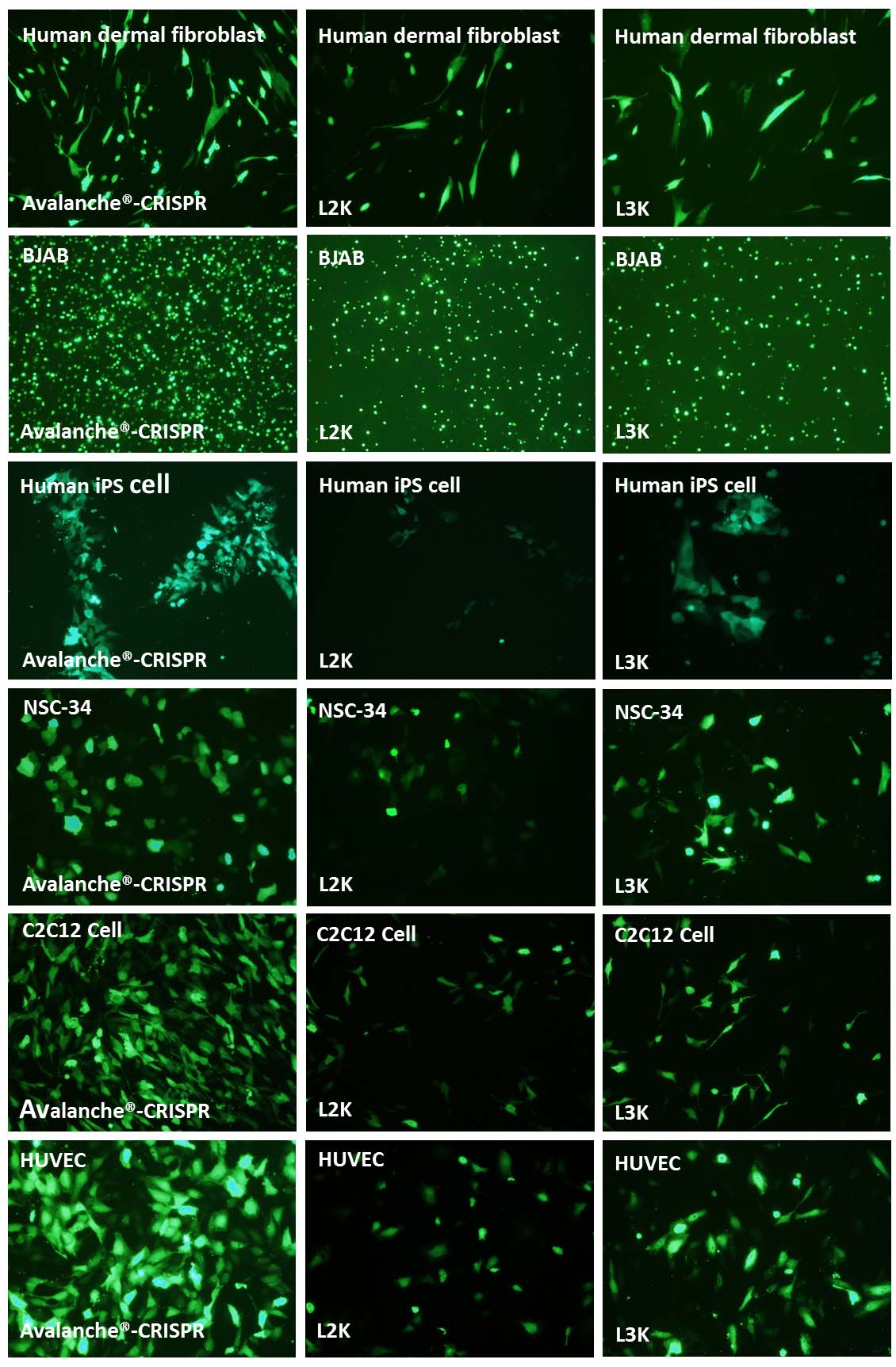
Avalanche®-CRISPR outperforms other brands of transfection reagents on transferring Cas9/GFP co-expression plasmids into some difficult-to-transfect cells. GFP expression in different type of cells after transfecting pCas9-GFP plasmid (Addgene #44719) by using Avalanche®-CRISPR, Lipofectamine® 2000 (L2K), and Lipofectamine® 3000 (L3K). The cells tested are: Human dermal fibroblast, BJAB (human Burkitt lymphoma cell), Human iPS cell, NSC-34 (Mouse Motor Neuron Hybrid Cell), C2C12 cell (mouse myoblast), and HUVEC (Human Umbilical Vein Endothelial Cell)
Citations or Feedback
- Nasuhidehnavi, A., Zhao, Y., Punetha, A., Hemphill, A., Li, H., Bechtel, T. J., Rager, T., Xiong, B., Petrou, V. I., Gubbels, M.-J., Weerapana, E., & Yap, G. S. (2022). A role for Basigin in Toxoplasma gondii infection. Infection and Immunity, 90(6), Article e00205-22. https://doi.org/10.1128/iai.00205-22
If you cannot find the answer to your problem then please contact us or telephone +44 (0)1954 210 200