Bst DNA Polymerase, Exonuclease Minus
Product information
Bst DNA Polymerase, Exonuclease Minus, is a recombinant form of the 67 kDa Bacillus stearothermophilus DNA Polymerase protein (large fragment). The enzyme has 5’-3’ polymerase activity and strand displacement activity, but it lacks 3’-5’ exonuclease activity. It also has reverse transcription activity.
Bst DNA Polymerase, Exonuclease Minus, has higher strand displacement activity than that of other suppliers (Figure 1). The enzyme can be used in nucleic acid amplification methods* such as isothermal amplification, whole genome amplification (WGA), and multiple displacement amplification (MDA). It also can be used in Next Generation sequencing.
Applications
Strand displacement amplification
DNA sequencing through high GC regions (1,2)
Rapid sequencing from nanogram amounts of DNA template (3)
This enzyme has optimal activity at 65°C. It is suitable for sequencing DNA with high GC content and secondary structures. It is available in concentrations of 8,000 U/ml or 50,000 U/ml.
Bst DNA Polymerase, Exonuclease Minus, is supplied with 10X DNA Polymerase Buffer B, composed of 200 mM Tris-HCl pH 8.8, 100 mM (NH 4) 2SO 4, 100 mM KCl, 20 mM MgSO 4, and 1.0 % Triton X-100.Product information
Bst DNA Polymerase, Exonuclease Minus, is a recombinant form of the 67 kDa Bacillus stearothermophilus DNA Polymerase protein (large fragment). The enzyme has 5’-3’ polymerase activity and strand displacement activity, but it lacks 3’-5’ exonuclease activity. It also has reverse transcription activity.
Bst DNA Polymerase, Exonuclease Minus, has higher strand displacement activity than that of other suppliers (Figure 1). The enzyme can be used in nucleic acid amplification methods* such as isothermal amplification, whole genome amplification (WGA), and multiple displacement amplification (MDA). It also can be used in Next Generation sequencing.
Applications
Strand displacement amplification
DNA sequencing through high GC regions (1,2)
Rapid sequencing from nanogram amounts of DNA template (3)
This enzyme has optimal activity at 65°C. It is suitable for sequencing DNA with high GC content and secondary structures. It is available in concentrations of 8,000 U/ml or 50,000 U/ml.
Bst DNA Polymerase, Exonuclease Minus, is supplied with 10X DNA Polymerase Buffer B, composed of 200 mM Tris-HCl pH 8.8, 100 mM (NH 4) 2SO 4, 100 mM KCl, 20 mM MgSO 4, and 1.0 % Triton X-100.
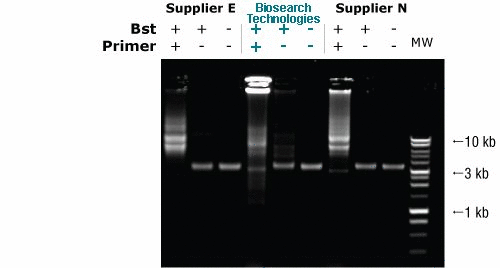
Figure 1. Bst DNA Polymerase, Exonuclease Minus, possesses greater strand-displacing polymerase activity. M13 single stranded DNA was incubated with or without 8 units of Bst DNA Polymerase( /- Bst) in reaction buffer supplied by the manufacturer, with or without replication primer ( /- primer) for 30 minutes at 65°C. MW, 1 kb ladder.
Tips for use:
Requires 0.1% Triton X-100 for long term storage.
Reaction temperatures above 70°C are not recommended.
Bst DNA Polymerase cannot be used for thermal cycle sequencing.
Heat Inactivation: 80ºC for 20 min.
References:
Griffin, H. and Griffin, A. (1994) PCR Technology, 228-229.
McClary, J. et al. (1991) J. DNA Sequencing and Mapping, 1, 173-180.
Mead, D.A. et al. (1991) Biotechniques, 11, 76-87.
If you cannot find the answer to your problem then please contact us or telephone +44 (0)1954 210 200